North Sea: Real Estate Prices on the Islands Are Falling
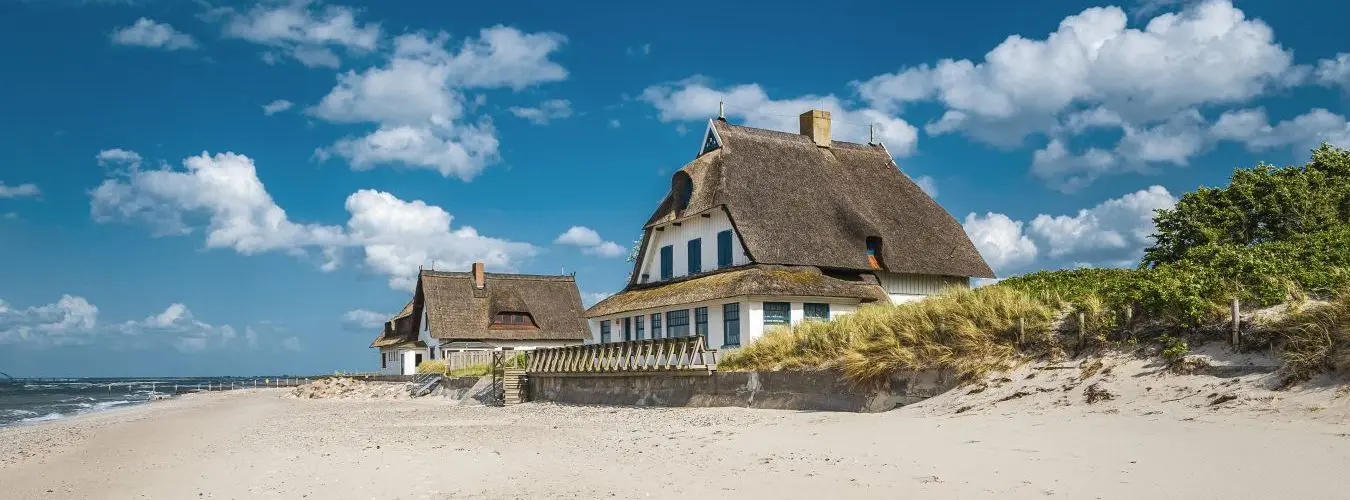
On the North Sea coast, much follows the rhythm of the tides. The tides bring constant change—both visible and reliable. A similar picture is currently emerging in the real estate market along the coast. Regional differences are becoming more pronounced again: While a positive trend is emerging in many mainland regions, the islands and individual counties are developing in a more varied manner—with noticeable deviations in price dynamics. Against this backdrop, the experts at VON POLL IMMOBILIEN took a closer look at real estate prices for single-family homes1 in the counties, independent cities, as well as on the peninsulas and islands* along the North Sea coast and compared the development of purchase prices2 in the first quarter of 2026 with the first quarter of 2025.
Daniel Ritter, managing partner at VON POLL IMMOBILIEN:
“We are currently seeing a clear differentiation in the real estate market along the North Sea coast: While prices in many mainland regions have stabilized and are in some cases rising again, the high-priced island markets in particular are under greater pressure to adjust. The declines on many North and East Frisian islands reflect a market phase in which supply and demand are converging more closely again, and price levels are realigning accordingly—also against the backdrop of the changed economic conditions since the end of 2022. At the same time, demand remains solid overall—though significantly more selective than just a few years ago. Today, buyers pay closer attention to factors such as a good location, energy efficiency, and sustainable rentability. In well-connected mainland locations, this is already leading to moderate price increases again, while the market as a whole is settling into a more stable and, in the long term, moderate level.”
As expected, the islands along the North Sea coast continue to lead the real estate price rankings in the first quarter of 2026. According to the report, prospective buyers will find the highest prices per square meter on the North Frisian Islands, which include Sylt, Amrum, and Föhr. Here, one square meter of living space costs an average of 9,922 euros. The island of Sylt plays a major role in the high price levels of the North Frisian Islands, as it has long been considered one of the most exclusive—and thus also most expensive—residential areas in Germany. A closer look at the Sylt real estate market reveals that average prices here, at around €12,557/m2, are once again significantly higher than on the rest of the North Frisian Islands. However, the trend in real estate prices here is quite surprising: While price levels on the North Frisian Islands had been rising almost exclusively for a long time, average home prices fell by -4.7 percent in the first half of 2026 compared to the previous year. This means the North Frisian Islands show the second-highest price reduction within the analysis. Real estate prices on Sylt also declined, albeit only slightly by -1.5 percent.
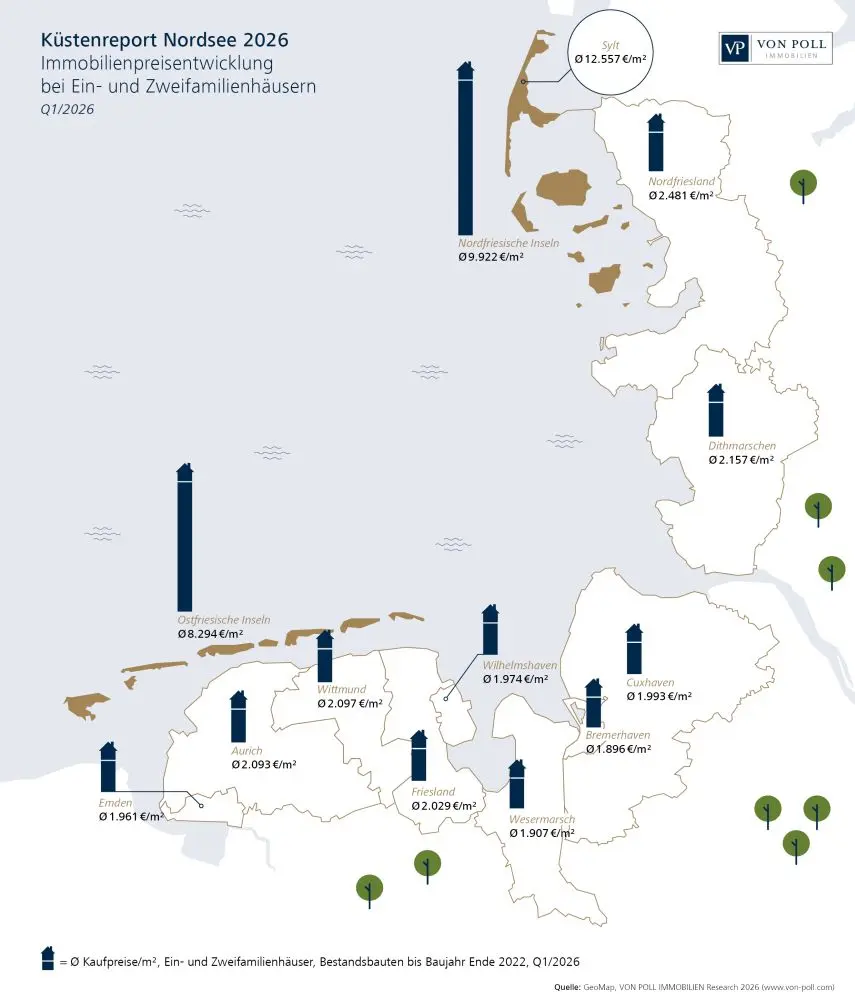
Fig. 1: Purchase prices for houses on the North Sea coast in the first quarter of 2026 (Graphic: von Poll Immobilien GmbH)
In second place—albeit with a significant gap of over €1,600/m2 less—is the next group of islands: The East Frisian Islands, which include Juist, Langeoog, and Norderney, for example. Prospective buyers here must expect to pay approximately €8,294/m2 for a house in good condition in the first quarter of 2026. There, too, real estate prices have declined compared to the first quarter of 2025. The East Frisian Islands thus recorded the sharpest price decline in the ranking, averaging -5.1 percent.
Significantly cheaper—with a difference of more than €5,800/m2 compared to the East Frisian Islands—is the mainland along the North Sea coast. Prices per square meter ranging from €2,500 to €2,000 were found in the first quarter of 2026 in the district of Nordfriesland (mainland only) at €2,481/m2, in the district of Dithmarschen at €2,157/m2, in the district of Wittmund (mainland only) at €2,097/m2, in the district of Aurich (mainland only) at €2,093/m2 , and in the district of Friesland (mainland only) at €2,029/m2.
Thorsten Lemcke, Branch Manager at VON POLL IMMOBILIEN Heide and Husum
“In our region on the North Sea coast, particularly around Heide and Sankt Peter-Ording, we are currently seeing a significantly expanded supply coupled with subdued demand. This trend can be attributed, among other things, to rising energy costs, general inflation, and increased uncertainty resulting from economic and geopolitical conditions. At the same time, the region remains attractive—especially for buyers from southern German states and Switzerland, for whom the price level here remains comparatively appealing. In our view, the differing price trends between the islands and the mainland are largely linked to structural factors. In heavily regulated vacation property markets such as Sankt Peter-Ording, the increased supply combined with stricter regulations has led to noticeable price reductions. We expect a sustained sideways trend here in the coming years, although older properties that have not been modernized for energy efficiency are likely to remain under pressure in particular.”
Here, too, it is worth taking a closer look at price trends in individual locations. While average prices for a house in the districts of Nordfriesland and Wittmund fell by 3.2 percent and 3.5 percent, respectively, prices in the other districts rose, in some cases significantly. For example, compared to the same period last year, house prices rose by 2.7 percent in the district of Aurich, by 3.7 percent in the district of Dithmarschen, and by as much as 5.7 percent in the district of Friesland. Thus, the districts of Dithmarschen and Friesland recorded the third-highest and highest price increases, respectively, in the entire ranking.
Quote box incl. image: Hermann Mehrtens, branch manager at VON POLL IMMOBILIEN Wilhelmshaven and Jever: “Supply and demand in our region are currently balanced—properties newly coming onto the market are sold without intense price negotiations. Nearly half of our clients come from other federal states—particularly North Rhine-Westphalia and Hesse—and often from the neighboring Netherlands as well. Vacation homes and second homes are clearly the focus for this clientele. However, regulatory conditions have tightened: municipalities are paying closer attention to compliance with zoning plans regarding use as a second home—particularly in Wangerland and on Wangerooge. The pandemic led to a significant excess of demand, causing real estate prices to rise rapidly. Current trends, however, indicate that the market is stabilizing again. Given the popularity of the North Sea coast as a vacation destination, we continue to expect prices to remain stable.”
Fig. 2: Purchase price trends for houses on the North Sea coast in the first quarter of 2026 compared to the first quarter of 2025 (Graphic: von Poll Immobilien GmbH)
Prospective buyers can find house prices per square meter below the 2,000-euro mark in the district of Cuxhaven at 1,993 €/m2, in the independent cities of Wilhelmshaven and Emden at 1,974 €/m2 and €1,961/m2, respectively, as well as in the Wesermarsch district at €1,907/m2. While average real estate prices in the first quarter of 2026 merely stagnated in the Cuxhaven district at -0.1 percent and in the independent city of Emden at 1 percent, price levels in the independent city of Wilhelmshaven and the Wesermarsch district climbed by 3.2 percent and 4 percent, respectively. Accordingly, the Wesermarsch district recorded the second-highest price increase in the analysis.
Nils Onken, Branch Manager at VON POLL IMMOBILIEN in East Frisia (Norden, Aurich, Emden, and Esens):
“Due to the current geopolitical situation, general uncertainty, and rising interest rates, demand is currently rather subdued. However, properties priced realistically still find suitable buyers quickly. Most of our clients—between 80 and 90 percent—purchase real estate as a primary residence and are primarily from the region, but also from Hesse and North Rhine-Westphalia. Especially on the islands and to some extent on the mainland as well, short-term rentals—which until now were merely tolerated but not officially approved—are generally no longer permitted after the properties have been sold. This, in turn, affects the property’s value—prices for properties without official approval are falling, while prices for actually approved vacation properties are rising. The future price trend remains intriguing: If interest rates continue to rise, prices will also ease slightly again. However, vacationing within one’s own country is becoming more attractive again—partly due to the geopolitical situation—which could provide a significant boost to certain locations in the future.”
The most affordable location is the independent city of Bremerhaven. There, the average price for a house in the first quarter of 2026 was €1,896/m2. Compared to the same period last year, average real estate prices here stagnated at 0.6 percent.
Baltic Sea: Island prices are falling, cities like Rostock are gaining traction
The Baltic Sea is considered the calmer counterpart to the North Sea. But a closer look reveals that beneath the surface, it, too, is constantly in motion. Currents and coastlines are shifting. The real estate market along the coast is currently following this pattern as well. Regional developments are increasingly diverging: While some county seats and mainland regions are seeing rising real estate prices, the opposite trend is evident on the islands and in certain coastal regions. Against this backdrop, the experts at VON POLL IMMOBILIEN took a closer look at real estate prices for single-family homes1 in the counties, independent cities, as well as on the peninsulas and islands* along the Baltic Sea coast and compared the development of purchase prices2 in the first quarter of 2026 with the first quarter of 2025.
Quote box incl. image: Daniel Ritter, managing partner at VON POLL IMMOBILIEN: “The real estate market on the Baltic Sea coast currently presents a more nuanced picture than in previous years: While many mainland regions and larger cities such as Rostock are on the rise again, certain high-priced coastal and island locations in particular are coming under increasing pressure. This contrasting trend—as seen in Fischland-Darß-Zingst and Rostock—illustrates that demand is increasingly focused on the quality of the location and the potential for vacation rentals. At the same time, the Baltic Sea remains a sought-after destination—albeit under changed circumstances. Against the backdrop of economic and geopolitical conditions, buyers are acting significantly more selectively and with a greater focus on security. Locations with prospects for long-term use are particularly in demand, while traditional second-home markets are adapting more noticeably.”
By a wide margin, properties on the Fischland-Darß-Zingst peninsula were among the most expensive on the Baltic Sea coast in the first quarter of 2026. Prospective buyers must currently expect to pay €5,138 per square meter here. In second place is the district and Hanseatic city of Rostock at €4,011 per square meter—more than €1,100 per square meter below the price level of the Fischland-Darß-Zingst peninsula. What is striking, however, is the opposite trend: While prices for houses on Fischland-Darß-Zingst have fallen by 5.7 percent compared to the first quarter of 2025—the sharpest price drop on the Baltic Sea coast—Rostock recorded a 7.5 percent increase over the same period, marking the highest price rise in the analysis.
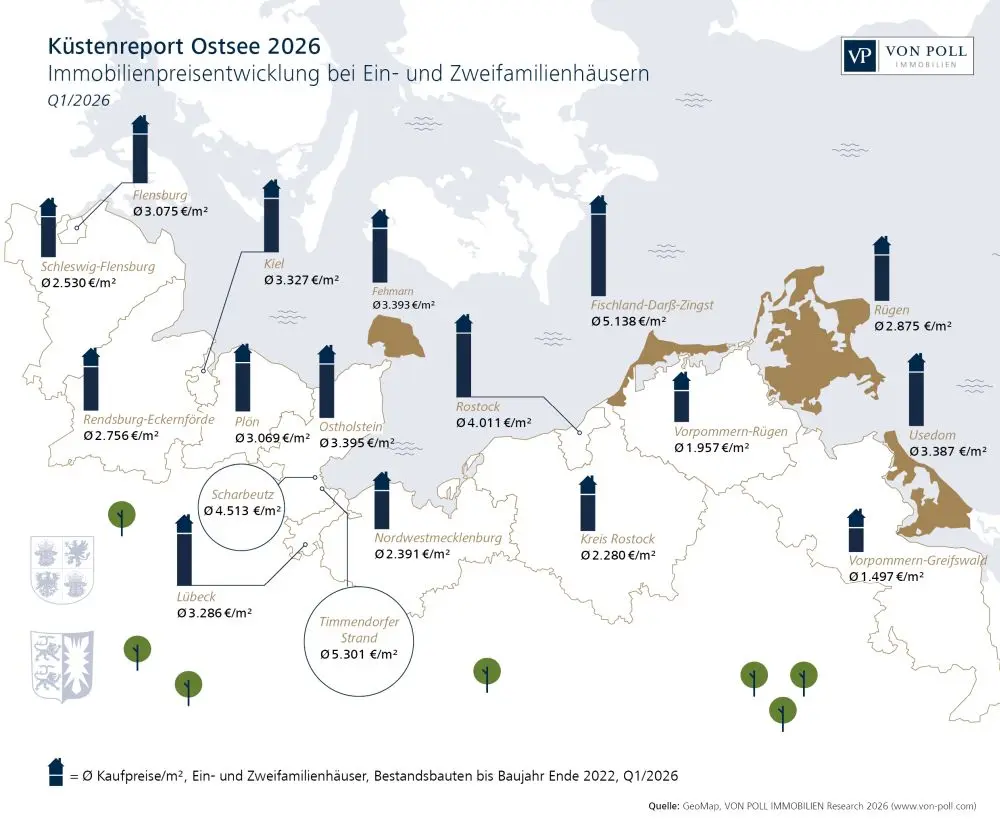
Fig. 1: Purchase prices for houses on the Baltic Sea coast in the first quarter of 2026 (Graphic: von Poll Immobilien GmbH)
Corinne Briesemeister, Branch Manager at VON POLL IMMOBILIEN Rostock and Warnemünde:
“We are currently seeing an oversupply, or rather an unusually high number of properties on the market—even in highly sought-after and otherwise supply-constrained areas around Rostock and Warnemünde. As a result, prospective buyers are acting much more cautiously and scrutinizingly, which is noticeably prolonging the sales process compared to last year. Demand still exists, however, and comes from a broad spectrum: In addition to regional buyers, many interested parties come from Berlin as well as from Saxony and Thuringia, along with returnees and buyers who are moving to the region for work. Overall, against this backdrop, we expect the market to continue developing at a stable, consistent price level.”
Real estate prices for houses in the Ostholstein district range between €3,400/m² and €3,000/m², with an average of €3,395/m², on the islands of Fehmarn at €3,393/m² and Usedom at €3,387/m², as well as in the district capitals of Kiel at €3,327/m², Lübeck at €3,286/m², Flensburg at €3,075/m², and the Plön district at €3,069/m². While mainland regions in this segment recorded rising prices per square meter ranging from 2.8 percent to 6.5 percent, prices for single-family and two-family homes on the islands of Fehmarn and Usedom fell by 5.5 percent and 4.8 percent, respectively, in the first quarter.
Fig. 2: Purchase price trends for houses on the Baltic Sea coast in the first quarter of 2026 compared to the first quarter of 2025 (Graphic: von Poll Immobilien GmbH)
Robert Rothböck, Branch Manager at VON POLL IMMOBILIEN in Kiel, Plön, Eckernförde, Rendsburg, Neumünster, and Eutin:
“We are currently observing overall stable demand in our region along the Schleswig-Holstein Baltic Sea coast, driven by both local and out-of-state buyers—particularly from metropolitan areas such as Hamburg, Berlin, and North Rhine-Westphalia. The focus is on both primary residences and vacation properties, which further underscores the appeal of the Baltic Sea coast. In our view, the difference in price trends between the islands and the mainland is primarily due to their intended use: While mainland locations are increasingly in demand for permanent residence, island properties are more often high-priced second homes—and these are more sensitive to market changes. For the coming years, however, we expect stable price trends for modern, well-equipped properties, while prices for properties in need of renovation are likely to continue to decline.”
Prospective buyers looking for a home on the Baltic Sea coast can find property prices ranging from €2,900/m² to around €2,200/m² in several regions: These include the island of Rügen at €2,875/m², the districts of Rendsburg-Eckernförde at €2,756/m², Schleswig-Flensburg at €2,530/m², Northwest Mecklenburg at €2,391/m², and the Rostock district at €2,280/m². Here, too, price trends are following the pattern seen so far: Prices per square meter in the mainland regions of Northwest Mecklenburg and Rendsburg-Eckernförde are rising by 7.1 percent and 4.7 percent, respectively, while the island of Rügen is seeing a 1.8 percent decline in real estate prices. However, the districts of Rostock (-1.6 percent) and Schleswig-Flensburg (-0.6 percent) also saw slight declines compared to the same quarter of the previous year.
Jessica Koppitz, Branch Manager at VON POLL IMMOBILIEN Neustadt in Holstein
“We are currently observing a clear shift in demand in our region around Neustadt in Holstein: While interest in traditional homes has noticeably increased, demand for vacation properties is declining. Many buyers are consciously choosing to relocate their primary residence to the Baltic Sea—primarily due to the high quality of life. Accordingly, properties are predominantly used as primary residences, with demand coming from both the region and other federal states such as Hamburg, North Rhine-Westphalia, Hesse, and Lower Saxony. At the same time, the regulatory framework for vacation properties has recently tightened significantly. In many areas, use is subject to approval or even prohibited, which also affects demand. For the coming years, we expect prices to remain stable overall—particularly for high-end properties—while properties in the mid-price segment will continue to be marketable.”
The lowest prices for single-family homes are found in the Vorpommern-Greifswald district, averaging €1,497/m², followed by the Vorpommern-Rügen district at €1,957/m². At the same time, prices in both regions fell in the first quarter of 2026—by -4.1 percent and -1.7 percent, respectively.
1 In this analysis, the terms “house” and “single-family home” refer to the following types of homes: single-family homes, two-family homes, townhouses, and semi-detached homes.
2 The data basis for the purchase price analysis is based on the average asking prices for existing single-family homes (up to and including 2022) from GeoMap for the first quarter of 2026 and the first quarter of 2025, as well as adjustments by VON POLL IMMOBILIEN Research (2026).
*North Sea: In the course of the analysis, islands and peninsulas were considered separately, and for the counties of Nordfriesland, Wittmund, Aurich, and Friesland, only the mainland was considered, excluding the respective islands.
*Baltic Sea: In the course of the analysis, islands and peninsulas were considered separately, and for the districts of Ostholstein, Vorpommern-Rügen, and Vorpommern-Greifswald, only the mainland was considered, excluding the respective islands.