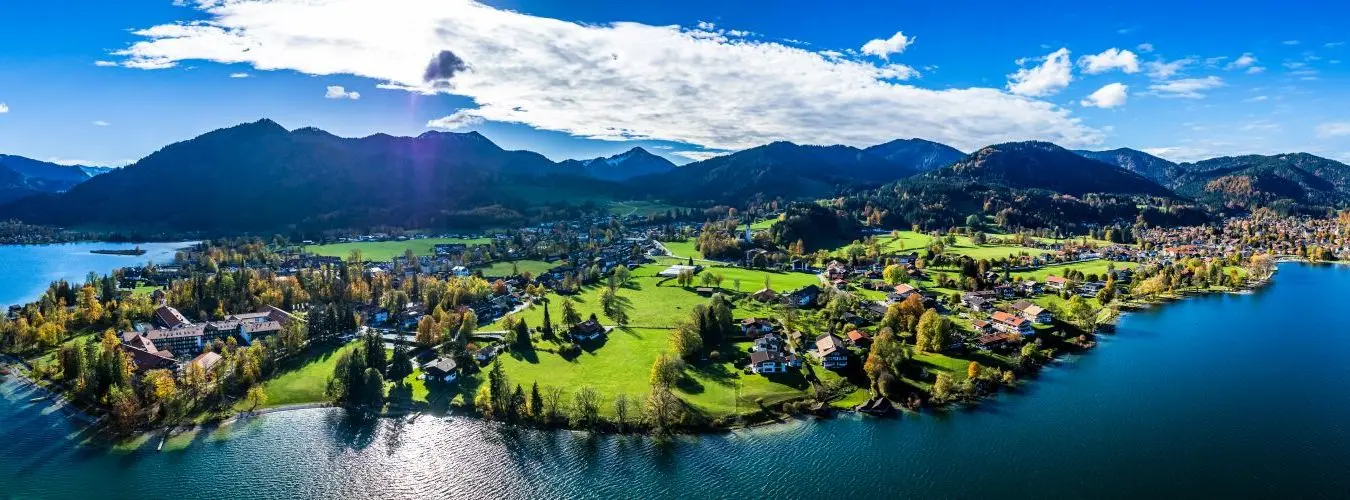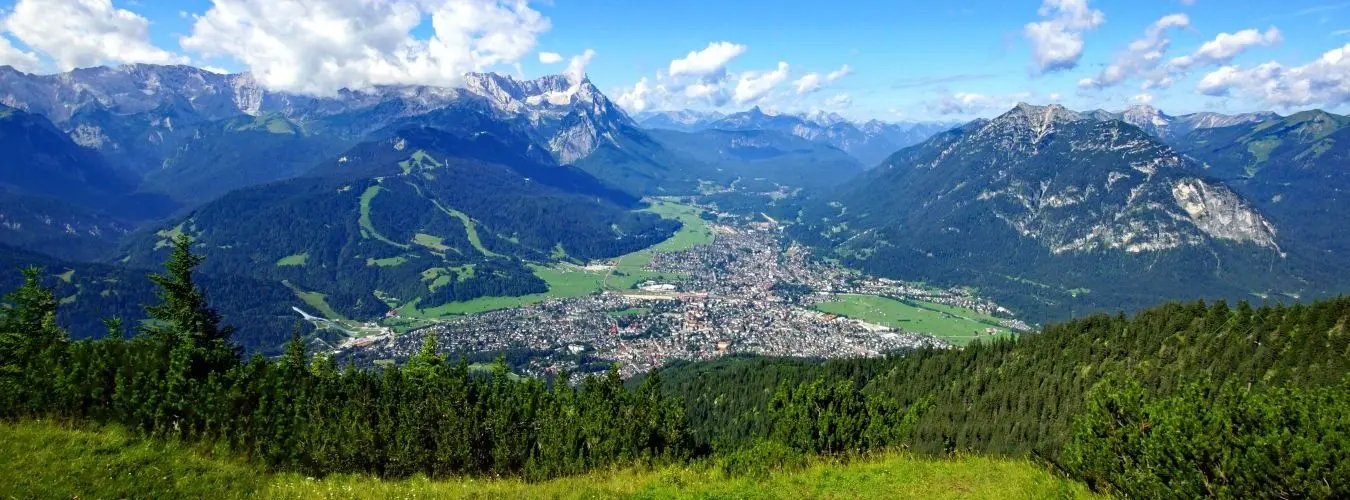
Rugged cliffs, impressive glaciers, and crystal-clear mountain lakes—the Alps impress with their diversity and reveal themselves in a new guise every season. Mountains are also considered the epitome of freedom, stability, and strength. So it's hardly surprising that the regions near the Bavarian Alps are also extremely popular with property buyers – whether as a primary or secondary residence. But how does this particularly high location quality affect property prices? The experts at VON POLL IMMOBILIEN have analyzed the development of averageasking prices for residential real estate in the nine Bavarian districts with direct access to the Alps, i.e., located inthe firstAlpine range, for the years 2020 to 2025 inclusive. The analysis also compares price developments between the Alpine districts in the first Alpine range and the districts further north in the secondrange.

"From a real estate perspective, the Bavarian Alpine foothills and the adjacent Alpine foothills represent high location quality and long-term stability. In times of increased global uncertainty, regions that offer a certain distance from these events, tranquility, and a permanently reliable living environment are gaining in importance. The combination of unspoiled nature, safety, year-round recreational value, efficient infrastructure, and good accessibility underscores the particular appeal of this location. This development is also reflected in prices: in all nine Bavarian districts analyzed with direct access to the Alps, real estate prices have risen compared to 2020 – in some cases significantly. In six districts, prices for residential property have risen by double digits by 2025, while the three frontrunners are approaching the 20 percent mark. A clear sign of the sustainable value retention of these regions.
Unsurprisingly, the district of Miesbach – home to Lake Tegernsee, which has always been one of the most sought-after and exclusive residential areas in Germany – will have the highest prices per square meter in 2025, putting it at the top of the ranking. With an average price of €7,702 per square meter, residential real estate here is the most expensive. The district of Garmisch-Partenkirchen follows at a considerable distance of over €1,100/m². Prospective buyers here must expect to pay around €6,558 per square meter of living space. Despite the already high price level, real estate prices in both districts have risen significantly over the past five years. While prices in the district of Miesbach rose by 9.6 percent in 2025 compared to 2020, the increase in the district of Garmisch-Partenkirchen was as high as 10.6 percent.
Fig. 1: Price development of residential real estate near the Alps, 2020 to 2025 inclusive (graphic: von Poll Immobilien GmbH)

"Demand for residential real estate remains unbroken, although prospective buyers are acting somewhat more selectively. Energy efficiency, location, and property quality are now more in focus. Second homes are also in greater demand – despite an increase in the second home tax, interest has risen significantly over the last five years. The clear drivers for this were the pandemic, increasing urban exodus, the establishment of home offices, and the growing importance of leisure value and location independence. Second homes are increasingly being used for longer stays and are often seen as a prospective retirement home. Pure capital investments are rather rare, as high purchase prices and a qualified rent index limit returns. In addition, municipal regulations counteract intensive vacation rentals.
Prospective buyers will find prices per square meter just below the €6,000 mark in the Bad Tölz-Wolfratshausen district at €5,964/m2 and in the Rosenheim district at €5,280/m2. Here, too, average real estate prices in 2025 have risen compared to 2020, albeit at a much more moderate rate. The district of Bad Tölz-Wolfratshausen saw the lowest price increase in the entire ranking at 3.9 percent, while the district of Rosenheim saw the second-lowest price increase at 7.3 percent.
In the other five Bavarian districts with direct access to the Alps, real estate purchase prices range between €4,000/m² and €5,000/m². Anyone wishing to purchase a property in the Lindau district (Lake Constance) can expect to pay around €4,834/m2, in the Traunstein district €4,630/m2, in the Berchtesgadener Land district €4,482/m2, and in the Oberallgäu district around €4,416/m2. The cheapest location is the Ostallgäu district, where the average price per square meter of living space in 2025 was €4,131.

"After a noticeable slowdown in 2023, demand for residential real estate has stabilized at a high level. Depending on marketability and price, the marketing period currently ranges from two weeks to four months. In Kempten, Isny, and northern Oberallgäu, search queries mainly relate to primary residences. The closer you get to the mountains – i.e., from Sonthofen and southwards – the search for a second home clearly comes to the fore. Whether as a retreat from the city, for vacation and leisure activities, or as a retirement home – the reasons are manifold."
It is particularly interesting to look at the price development in the districts within the price segment between €4,000/m² and €5,000/m², as these show the highest increases in the entire ranking. The frontrunner here is the district of Ostallgäu, where average real estate prices in 2025 have risen by 19.8 percent compared to 2020, closely followed by the district of Lindau (Lake Constance) with an increase of 19.6 percent and the district of Traunstein with 19.5 percent. The district of Oberallgäu also recorded a respectable increase, with average prices climbing by 15.2 percent. At a total of 11.3 percent, residential property prices in the district of Berchtesgadener Land have risen at a comparatively moderate rate over the five-year period.

"Demand remains high, but sellers are still reacting slowly to current market developments in some cases – especially in Berchtesgadener Land. In the district of Traunstein, on the other hand, a greater willingness to adapt is already evident. The number of search queries relating purely to second homes varies greatly from region to region. This is partly because many municipalities, such as Bad Reichenhall, have introduced a second home tax or, like Schleching and Unterwössen, no longer allow new second homes to be established. The main motivation for buying is clearly to use the scenically attractive region with its diverse leisure activities as a retirement home. Particularly noteworthy are the good medical infrastructure, the cultural offerings, and the proximity to Salzburg.
Fig. 2: Price development of residential real estate near the Alps, 2020 to 2025 inclusive (graphic: von Poll Immobilien GmbH)
A look at the price development for residential real estate in the first row of the Alps clearly shows that the nine Bavarian districts with direct access to the Alps benefit significantly from their proximity to the mountains. Overall, the price per square meter in the districts on the edge of the Alps rose by 11.8 percent to €5,204 in 2025 compared to 2020. This means that the price level in the districts in the first Alpine range has risen twice as much as in the districts in the second Alpine range. This is because prices in these districts have risen by only 5 percent since 2020, although the average price per square meter here is slightly higher at €5,489. The reason for this is that the districts of Munich and Starnberg, which have always had high price levels, fall geographically into the second Alpine range cluster and accordingly drive up the average purchase price.
In addition to the districts of Munich and Starnberg, the second Alpine range also includes the districts of Ebersberg, Landsberg am Lech, Mühldorf am Inn, Unterallgäu, Altötting, and Weilheim-Schongau, as well as the independent cities of Kempten (Allgäu), Kaufbeuren, and Rosenheim.
1The data basis for the purchase price analysis is based on the average asking prices for single-family and two-family houses as well as condominiums from empirica-regio (VALUE market data) for the years 2020 to 2025 inclusive.
2The analysis covered the nine southernmost Bavarian districts bordering Austria with direct access to the Alps, i.e., located in the first Alpine range, as defined and classified by VON POLL IMMOBILIEN Research (2026): Miesbach, Garmisch-Partenkirchen, Bad Tölz-Wolfratshausen, Rosenheim, Lindau (Lake Constance), Traunstein, Berchtesgadener Land, Oberallgäu, and Ostallgäu.
3According to the definition and classification of VON POLL IMMOBILIEN Research (2026),the second Alpine range includes the districts of Munich, Starnberg, Ebersberg, Landsberg am Lech, Mühldorf am Inn, Unterallgäu, Altötting, and Weilheim-Schongau, as well as the independent cities of Kempten (Allgäu), Kaufbeuren, and Rosenheim.
All data and graphics may be used and published with reference to the following source: von Poll Immobilien GmbH (www.von-poll.com). The graphic and table can be downloaded digitally with an embed link here: