Why a Higher Number of Older Homeowners Doesn’t Automatically Lead to a Wave of Sales
Millions of baby boomers will reach retirement age in the coming years. Many of them own single-family homes. This has led to a seemingly simple prediction: As this generation ages, a large number of homes will come onto the market, supply will increase, and real estate prices will come under pressure.
But can this calculation actually be applied to the County of Bentheim?
I think that’s too simplistic. Demographic change will transform our real estate market. However, there are many indications that this will happen gradually and, above all, will have very different effects on individual properties.
Baby boomers aren’t selling all at once
Even the idea of a sudden wave of sales is problematic. The baby boomer generation consists of several cohorts with high birth rates. The transition to retirement and, later, the transfer of their properties will therefore be spread out over many years.
Furthermore: Retirement is not a reason to sell.
Many homeowners want to live in their familiar home for as long as possible. A home is not just an asset. It is the center of their lives, their neighborhood, and often a debt-free home.
Even an inheritance does not automatically mean that a house will come onto the real estate market. A spouse can continue to live there. Children can take over the home themselves. It can be transferred within the family or subsequently rented out.
Only when the owners actually decide to sell does additional supply emerge.
FACT CHECK
Retirement ≠ automatic home sale
Inheritance ≠ automatic listing for sale
More older homeowners ≠ more homes on the market
Demographic change is therefore, first and foremost, a shift in the ownership structure. Only then will it become clear which portion of this housing stock actually enters the open market.
Lower Saxony is aging
However, downplaying the demographic effect would be just as wrong.
The Lower Saxony State Office for Statistics expects a significant shift in the age structure. The number of people aged 65 and older is projected to rise from around 1.86 million in 2024 to approximately 2.28 million in 2045. This corresponds to an increase of 22.7 percent. At the same time, the population aged 20 to 64 is expected to decline by about 15 percent.
A regional perspective is particularly interesting here. The State Office, for example, estimates that the number of people of working age in Nordhorn will decline by only about 6.1 percent by 2045. Statewide, however, a decline of 15 percent is expected.
That is precisely why I believe it is wrong to apply nationwide demographic trends directly to our regional real estate market.
What do the figures show for the County of Bentheim?
This is where the analysis becomes particularly interesting.
According to the real estate market data we analyzed, 1,077 single-family and two-family homes were sold in the County of Bentheim in 2025. That was 8.4 percent more than in the previous year.
The average purchase price was around 274,000 euros, which is about 4.7 percent higher than the previous year.
The overall market in Lower Saxony is also showing significantly more activity again. In 2025, approximately 29,500 single-family and two-family homes were sold statewide. That was eight percent more than in the previous year. The average purchase price rose from 255,000 to 270,000 euros. The appraisal committees expressly point out that prices have recently fallen more frequently in major cities than in rural areas.
Our current analysis of the supply market shows that, as of early August 2026, there were 488 homes listed for sale throughout the county of Bentheim, of which 153 in Nordhorn alone.
Therefore, there is no question of a market that is already characterized by a demographic-driven oversupply.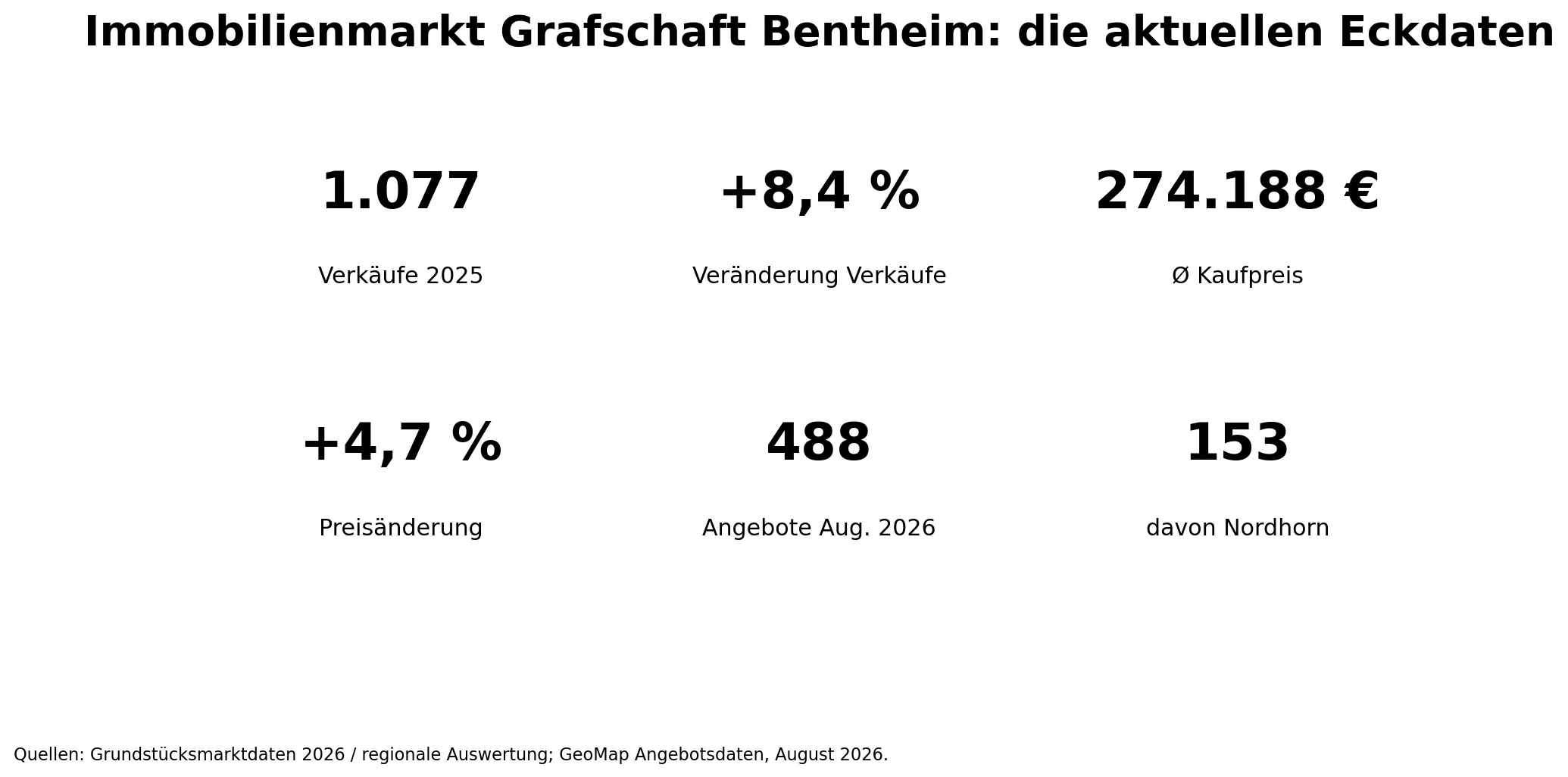
Important: Listing figures should not be equated with actual notarized purchase prices.
Affordability also plays a role
One additional point is often overlooked in the discussion about baby boomers: Increased supply only leads to significant downward pressure on prices if, on the other hand, demand is lacking.
In this regard, the County of Bentheim currently has comparatively favorable conditions.
The current Interhyp IW Affordability Index not only examines real estate prices but also compares the cost of financing a single-family home to the disposable income of a model household. This is precisely what makes it easier to compare regional markets with one another.
For the County of Bentheim, the calculated burden amounts to about 29 percent of disposable net household income.
Homeownership therefore remains comparatively affordable here relative to incomes. This is an important distinction from regions where high real estate prices coincide with weak demographic trends.
The generational shift will happen nonetheless
Over the next ten to twenty years, more and more properties owned by older homeowners will be passed on or sold.
I consider this very likely.
However, I do not expect a sudden wave of sales, but rather a long-term generational shift in the housing stock.
And with that, the key question changes.
Not:
How many homes do baby boomers own?
But rather:
Which of these homes will the next generation want to take over, and at what price?
It’s not age that matters, but the home
This is where the real estate market is likely to become more differentiated.
A well-maintained single-family home in a sought-after location in Nordhorn, Bad Bentheim, or another popular area of the county faces a different level of demand than a building that has barely been modernized in decades.
Especially for homes built in the 1950s, 1960s, and 1970s, the roof, windows, heating system, electrical wiring, plumbing, and energy efficiency may require significant investment.
As a result, buyers are increasingly looking beyond just the purchase price.
They ask:
How much will this house cost me after the purchase?
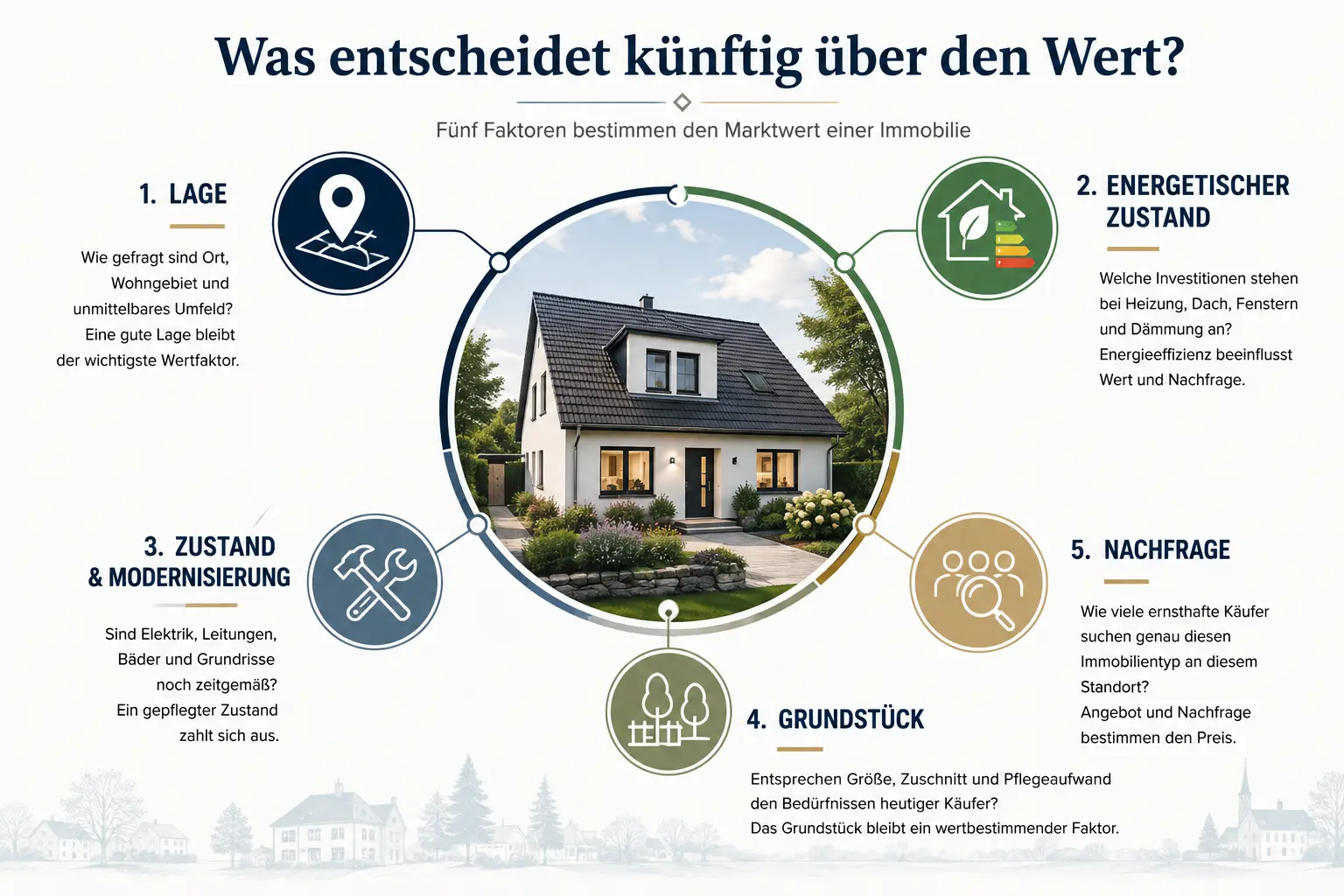
FIVE FACTORS ARE BECOMING EVEN MORE IMPORTANT
1. Location
How in demand are the town, neighborhood, and immediate surroundings?
2. Energy Efficiency
What investments are needed for the heating system, roof, windows, and insulation?
3. Modernization
Are the electrical system, plumbing, bathrooms, and floor plan still up to date?
4. Lot
Do the size and maintenance requirements meet the needs of today’s buyers?
5. Demand
How many serious buyers are looking for exactly this type of property in this location?
An Opportunity for Young Families
However, the generational shift also has a positive side.
As more and more existing homes owned by older homeowners gradually come onto the market, young families in particular can benefit.
After all, an existing home doesn’t need to be built from scratch. The lot, utilities, and infrastructure are already in place. Many older single-family homes also offer lot sizes that are rarely found in today’s new development areas.
A demographic problem can thus certainly turn into an opportunity: Existing housing is once again becoming available to families who need it.
However, this depends on the purchase price and the necessary modernization being in line with each other.
My conclusion for the County of Bentheim
The baby boomers will change the real estate market in the County of Bentheim. However, I do not consider a sudden slump in real estate prices solely due to this generation to be plausible.
The trend is spread out over too long a period for that to happen. Furthermore, by no means every house will be sold.
More likely is a generational shift in the housing stock, in which the differences between individual properties will become even more pronounced.
Properties in good locations, with reasonable energy efficiency, and at market-driven prices should continue to attract buyers. Properties in need of significant modernization, on the other hand, will have to compete more on price.
The crucial question, therefore, is not how many baby boomers own a home. What matters is when these homes actually come onto the market and how many buyers will be looking to purchase them in the county of Bentheim.
Sources and further information
Lower Saxony State Office for Statistics:
Demographic Aging of the Population Expected in Lower Saxony
Lower Saxony State Office for Statistics:
Demographic Change in Lower Saxony Through 2045
Appraisal Committees for Property Values in Lower Saxony:
Real Estate Market Data 2026
Appraisal Committees for Real Estate Values in Lower Saxony:
Lower Saxony State Real Estate Market Data 2026
German Economic Institute (IW Cologne):
Interhyp IW Affordability Index 2026
| Address |
Bentheimer Straße 9
48529
Nordhorn
|
| Tel. | +49 5921 - 71 39 93 0 |
| [email protected] |
Bentheimer Straße 9
48529 Nordhorn
| Tel. | +49 5921 - 71 39 93 0 |
| [email protected] |