Between Hamburg’s city limits and the surrounding area, location is no longer the sole factor determining a property’s appeal. Issues such as energy efficiency, future heat supply, and long-term operating costs now influence purchasing decisions more than they did just a few years ago. Prospective buyers are paying increasing attention to a property’s energy features and evaluating its long-term cost-effectiveness more closely. In addition to location, size, and condition, the choice of energy source is thus becoming increasingly important. Against this backdrop, the experts at VON POLL IMMOBILIEN analyzed the asking prices of residential properties1 by energy source2 in the first quarter of 2026 and examined trends compared to the same period the previous year. Four energy source groups were examined: first, solar, air, water, and geothermal energy; second, district heating and electricity; third, gas and natural gas; and fourth, oil.
Quote box incl. image: Daniel Ritter, managing partner at VON POLL IMMOBILIEN: “In the Hamburg metropolitan area, the picture currently varies greatly across the individual energy sources. While properties with renewable heating systems are gaining significant ground in many regions, gas and oil heating systems are not showing uniform trends—in several counties, they are even remaining stable or increasing. This shows that prospective buyers are taking a very close look at the specific property and its surroundings. Today, prospective buyers are much more discerning than they were a few years ago and consider the overall situation of a property. In the Hamburg metropolitan area in particular, it is not just the energy source that is decisive, but above all the interplay of location, condition, need for modernization, and price level. However, in the best locations, properties with any type of heating system continue to find buyers.”
Renewable heating systems are seeing the highest increases in value
The strongest price increases in the Hamburg metropolitan area are seen in residential properties with solar, air, water, or geothermal heating. Lüneburg leads the way with an average increase of 14.8 percent in the first quarter of 2026 compared to the same period last year, reaching an average of 4,430 €/m². It is followed by Pinneberg, with a 12.5 percent increase to 5,539 €/m²; Herzogtum Lauenburg, with an 11.1 percent increase to 3,613 €/m²; Harburg with 7.8 percent to 4,618 €/m², Stormarn with 4.8 percent to 4,589 €/m², and Segeberg with 3 percent to 4,086 €/m².
While price trends in most districts surrounding Hamburg are positive, Stade, at -1.7 percent to 3,892 €/m², is the only region to show a slight decline in the first quarter of 2026 compared to the first quarter of 2025.
The city of Hamburg remains the most expensive market in the analysis for properties equipped with solar, air, water, and geothermal heating systems, with an average price of 6,569 €/m². However, stronger price momentum is evident in the surrounding region as a whole: there, asking prices for residential properties with renewable heating systems rose by an average of 9.5 percent in the first quarter of 2026—nearly twice as much as in the city of Hamburg.
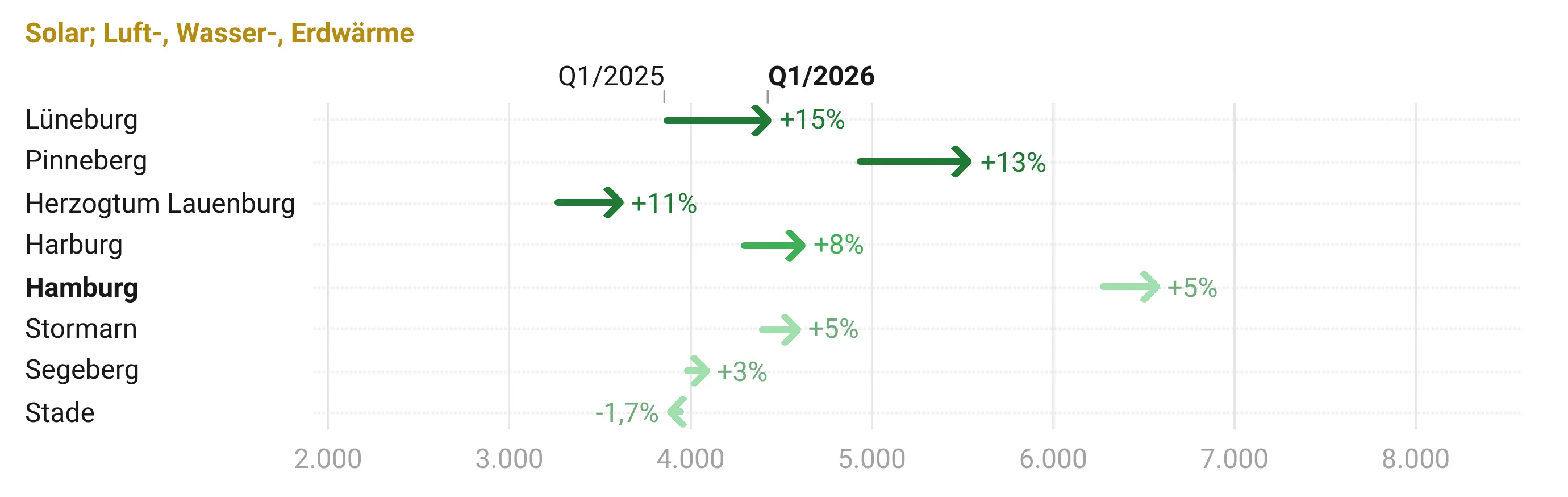
Fig. 1: Price trends for residential properties with solar, air, water, or geothermal heating in Hamburg and the surrounding area in the first quarter of 2026

“Many prospective buyers today want to be able to estimate as accurately as possible, even before making a purchase, what investments they’ll face in the coming years and what ongoing costs to expect. Consequently, in Lüneburg and Winsen, there is significantly more discussion about energy performance certificates, heating systems, insulation, and the need for modernization than there was a few years ago. Properties with modern heating technology offer many prospective buyers greater planning certainty and are viewed positively as a result. At the same time, properties with older gas or oil heating systems continue to find buyers if the location, condition, and price are right. Overall, we’re observing that buyers today distinguish more clearly between necessary and optional modernization measures and evaluate a property’s energy efficiency in a much more nuanced way than they did a few years ago.'
Dynamic Growth in District Heating and Electricity
The district heating and electricity-based real estate segment is also showing clear growth in the Hamburg metropolitan area. Pinneberg recorded the highest price increase, averaging 12.9 percent to €4,396/m². It is followed by Harburg with 9.7 percent to €4,287/m², Stormarn with 7.8 percent to €4,885/m², Segeberg at 6.2 percent to 3,947 €/m², and the Duchy of Lauenburg at 4.5 percent to 3,587 €/m².
In contrast, Stade recorded a slight decline in the first quarter of 2026, averaging -6.5 percent to 3,178 €/m², as did Lüneburg, which fell by -8.8 percent to 3,947 €/m².
A comparison of the surrounding areas with the city of Hamburg also reveals significant differences in residential properties with district heating or electricity. With an average of 8,029 €/m², the Hanseatic city not only had the highest price level in the first quarter of 2026 but also recorded a significantly stronger price trend—7.7 percent—compared to the same period the previous year than the Hamburg surrounding area as a whole. There, asking prices for residential properties with district heating or electricity rose by an average of 0.9 percent to 4,099 €/m² in the first quarter of 2026.

“Energy efficiency and the condition of a property have become significantly more important to prospective buyers in recent years. In the Pinneberg district, we frequently find that prospective buyers are specifically asking about the energy performance certificate, the age of the heating system, the insulation standard, and potential renovation measures as early as the first viewings. Especially with older properties, the expected investment costs are now evaluated much more closely than they were a few years ago. Properties with heat pumps or district heating are often seen as an advantage, as many buyers value predictable energy costs and minimal need for modernization. At the same time, potential replacement and renovation costs for older heating systems play a much greater role in price negotiations. Nevertheless, the type of heating system is usually only one part of the overall picture—location, condition, floor plan, and price continue to play an equally important role in the purchase decision.'
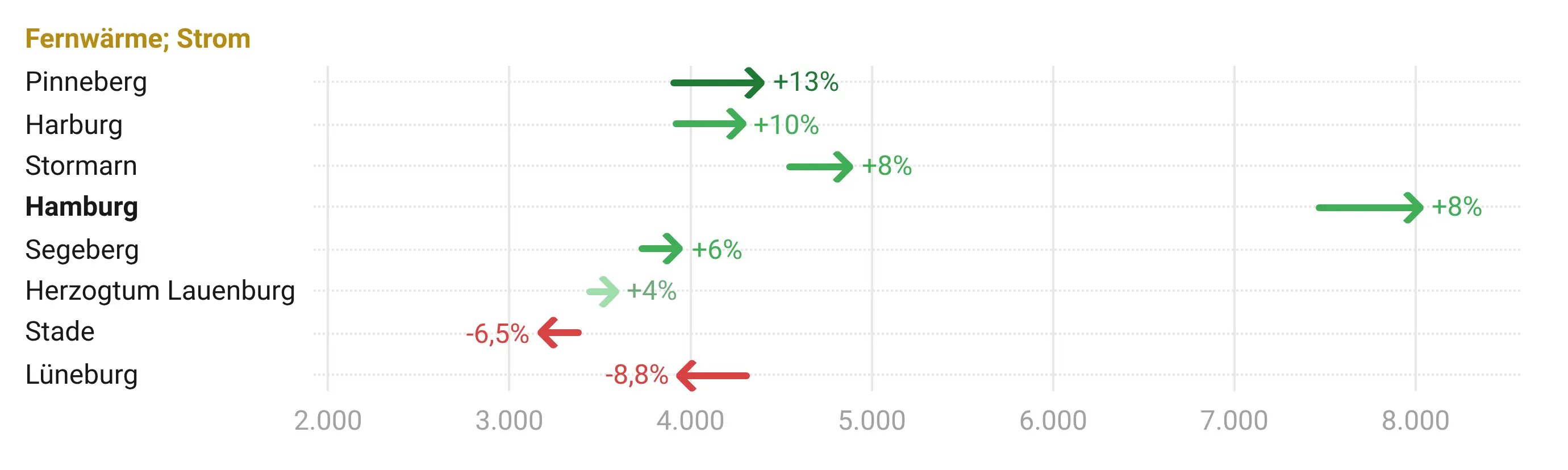
Fig. 2: Price trends for residential properties with district heating and electricity in Hamburg and the surrounding area in the first quarter of 2026
Mixed picture for properties with gas heating
The trend for residential properties with gas heating is significantly more varied. Harburg recorded the strongest price increase in the first quarter of 2026, rising 4.9 percent to 3,527 €/m². This was followed by Stade, up 0.7 percent to 2,853 €/m², and Pinneberg, up 0.6 percent to 3,614 €/m².
In Stormarn, where prices rose by 0.1 percent to 3,687 €/m², and in Segeberg, where prices fell by 0.1 percent to 3,468 €/m², real estate prices in this segment remained virtually stable. By contrast, price declines were observed in the first quarter of 2026 in Lüneburg, down 1.1 percent to 3,130 €/m², and in Herzogtum Lauenburg, down 2.6 percent to 3,034 €/m².
When comparing the metropolitan area with its surrounding regions, the market environment for residential properties with gas heating remains largely stable. While real estate prices in the Hamburg metropolitan area as a whole are largely moving sideways by 0.3 percent to an average of 3,379 €/m², Hamburg recorded a moderate decline of -1.5 percent to 5,175 €/m² in the first quarter of 2026.
Quote box incl. image: Volker Dallmann, Branch Manager at VON POLL IMMOBILIEN in Buxtehude, Stade, and Hamburg-Harburg: “The type of heating system and a property’s energy efficiency play a significantly greater role for prospective buyers today than they did a few years ago. In our region, we’re seeing stronger demand for properties with heat pumps, while oil-fired heating systems are significantly less in demand among many prospective buyers. Gas heating systems, on the other hand, are still widely regarded as a practical and accepted solution. The need for modernization and future energy costs have now become central topics in conversations with clients. District heating still plays a relatively minor role in our market area. At the same time, our discussions show that the Building Energy Act is a major concern for many buyers and is driving an increased need for information.”
Insert chart + Copy caption
Fig. 3: Price trends for residential properties with gas/natural gas heating in Hamburg and the surrounding area in the first quarter of 2026 (Graphic: von Poll Immobilien GmbH)
Oil-fired heating systems present a mixed picture in the Hamburg area
Residential properties with oil-fired heating are performing surprisingly robustly in the Hamburg area. Real estate prices rose particularly sharply in the Duchy of Lauenburg: There, they rose by 10.2 percent in the first quarter of 2026 compared to the same period the previous year, reaching an average of 2,713 €/m². Harburg also saw a 9.8 percent increase to 3,060 €/m², Lüneburg, up 7.7 percent to 2,434 €/m²; Stade, up 5.7 percent to 2,358 €/m²; and Pinneberg, up 3.2 percent to 3,343 €/m², all recorded price increases.
Prices for residential properties with oil heating remain relatively stable in Segeberg, rising by 0.5 percent to 2,752 €/m². A decline was seen only in Stormarn, where prices fell by 3.2 percent to 3,326 €/m² in the first quarter of 2026.
The segment of oil-heated residential properties is showing a particularly striking trend when comparing the metropolitan area with its surrounding regions. While asking prices in the Hamburg metropolitan area as a whole rose by an average of 4.6 percent to 2,937 €/m², the city of Hamburg remained virtually flat, with a slight decline of -0.2 percent to 4,718 €/m².
Insert chart + Copy caption
Fig. 4: Price trends for residential properties with oil heating in Hamburg and the surrounding area in the first quarter of 2026 (Graphic: von Poll Immobilien GmbH)
Quote box incl. image: Sandra Lundt, Branch Manager at VON POLL IMMOBILIEN Hamburg-Elbvororte: “In western Hamburg, buyers are currently primarily concerned with the implications of the Building Energy Act, necessary modernization measures, and the development of future energy costs. Many buyers are paying much closer attention to a property’s energy efficiency than they did a few years ago and are factoring potential modernization requirements as well as expected follow-up costs more heavily into their purchasing decisions. Often, the specific type of heating system is less of a deciding factor than the total investment the buyer will have to make. The sharp rise in construction and contractor costs has made energy-efficiency renovations significantly more expensive and complex today. While an older oil or gas heating system alone rarely serves as a deal-breaker, a low energy efficiency standard and extensive modernization needs are increasingly influencing pricing. Properties are in particularly high demand when buyers can easily calculate the necessary investment costs.”
Embed interactive graphic – see link: https://www.datawrapper.de/_/ZztSg
+ Copy caption
Fig. 5: Residential real estate price trends by energy source in Hamburg and the surrounding area in the first quarter of 2026 (Graphic: by Poll Immobilien GmbH)
All data and charts may be used and published with a reference to the following source: VON POLL IMMOBILIEN (www.von-poll.com)
The interactive charts can be downloaded here with an embed link:
1 The data for the purchase price analysis is based on the average asking prices for condominiums and single-family- and two-family homes in Hamburg and the surrounding area (all adjacent cities and counties) provided by GeoMap for the first quarter of 2026 compared to the first quarter of 2025, as well as adjustments made by VON POLL IMMOBILIEN Research (2026).
2 As part of the analysis, energy sources were grouped into the following heating types: first, solar, air, water, and geothermal heat; second, district heating and electricity; third, gas and natural gas; and fourth, oil. Wood/pellets were also included in the analysis but, due to the small number of offers, are not representative and are not listed.