






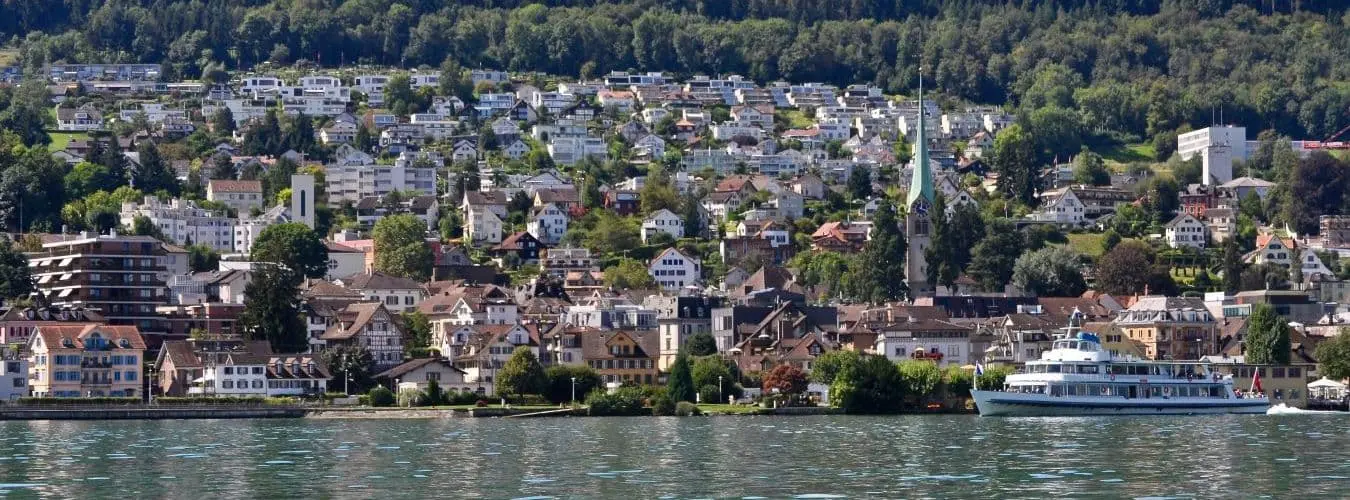
Vom Geheimtipp zur „Platinküste': Im Interview verrät Dr. Steffi Buzziol-Labas, was Wohnen am linken Zürichseeufer heute so begehrt macht – und welche Lagen besonders gefragt sind.
Buying a property is one of the most significant financial decisions in life. In the Canton of Zurich, prospective buyers will also come across apartments and single-family homes that are not offered as traditional freehold properties, but rather under building rights. Many prospective buyers are initially hesitant because they are unfamiliar with the concept of building rights. However, properties under building rights in the Canton of Zurich can be an attractive way to acquire home ownership in sought-after residential areas—often at a significantly lower purchase price than comparable properties held under full ownership.
As real estate experts, we at VON POLL IMMOBILIEN Lake Zurich Platinum Coast we regularly assist buyers and sellers of leasehold properties. Our experience shows that those who understand the specifics and carefully review the relevant building lease agreement can make an informed assessment of whether this form of ownership aligns with their own financial and personal goals.
In this guide, we explain how building rights work, what advantages and unique features they offer, what you should keep in mind when buying and financing, and what questions should be clarified before making a purchase decision.
Building Rights at a Glance
-
You own the building or apartment, but not the land: The land remains the property of the grantor of the building right.
-
You pay ground rent: A contractually agreed ground rent is paid for the use of the land.
-
Leasehold contracts are long-term: Terms ranging from, for example, 60 to 99 years provide a long-term basis for use.
- The purchase price can be significantly lower: Since the land is not purchased, a building lease property can be considerably more affordable than a comparable property held in full ownership.
What does a building leasehold property mean?
With a building lease, you acquire the building or the condominium unit, but not the land. The land remains the property of the so-called building lease grantor. This may be, for example, a municipality, a foundation, a cooperative, or another landowner.
The leaseholder pays an annual ground rent for the use of the land. In return, the leaseholder has the right to use the land for the contractually agreed term in accordance with the provisions of the building lease agreement.
In terms of day-to-day living, a property under a building lease differs little from a property held in full ownership. You live in your own house or apartment and, in principle, can sell, bequeath, or mortgage the property. However, the specific provisions of the respective building lease agreement always take precedence.
Why is a building lease attractive in the Canton of Zurich?
Land is a scarce and, consequently, valuable commodity in the Canton of Zurich, particularly in sought-after residential areas around Lake Zurich. Building rights allow landowners to retain ownership of the land long-term while simultaneously enabling its use for residential purposes.
This can result in a significant advantage for buyers: Since the land value is not included in the actual real estate purchase, the entry price can be substantially lower than for a comparable property that includes the land.
Especially in high-priced residential areas, building rights can therefore be attractive to buyers who wish to purchase a home without having to finance the full value of the land at the same time.
What are the advantages of a property with building rights?
Whether building rights are the right solution always depends on the specific property, the contract, and the buyer’s personal situation. Nevertheless, there are some fundamental advantages:
- A more attractive purchase price compared to comparable properties held in full ownership
- Access to sought-after residential areas that might otherwise be beyond one’s budget if purchased in full ownership
- Long-term security of use compared to a traditional lease
- The property can generally be sold and passed down through inheritance
- Individual use and design are possible within the legal and contractual framework
Depending on the land value and the terms of the building lease, the purchase price may be significantly lower than that of a comparable property held in full ownership. However, a blanket discount cannot be applied to every property. The decisive factors are, in particular, location, land value, the amount of the building lease fee, the remaining term, and the terms of the contract.
The building lease fee—a decisive factor
The lower purchase price is only one side of the story. Since the land is not purchased, the building leaseholder pays a building lease fee for its use.
Before purchasing, therefore, one should not only consider the current amount of the ground rent. At least as important is the question of how the ground rent may change over the remaining term of the contract. The relevant adjustment mechanisms are specified in the respective building lease agreement.
To make an informed purchase decision, therefore, both the purchase price and the long-term costs associated with the building lease should be factored into the overall assessment.
Buyers should review these points in the building lease agreement
For a property under a building lease, the building lease agreement is one of the key documents in the due diligence process. The following points are particularly important:
- What is the current ground rent?
- According to what formula or criteria can the building lease fee be adjusted?
- How much longer does the building lease agreement run?
- What provisions apply in the event of a future sale?
- What regulations apply to renovations and structural alterations?
- How is reversion at the end of the contract term handled?
- What compensation provisions are in place for reversion?
The remaining term is particularly important. It not only affects the buyer’s long-term outlook but can also be relevant for financing and a future resale.
Financing and Mortgages for Real Estate Under Building Lease Rights
A common question from prospective buyers is: Can a property under building rights even be financed with a mortgage?
In principle, yes. However, banks sometimes assess properties under building rights according to different criteria than traditional freehold properties. Not every financial institution evaluates a property under building rights in the same way, which is why financing terms may vary.
- Not every bank finances every building right model.
- The maximum loan-to-value ratio may be lower than for freehold properties.
- Depending on the property and the bank, a higher down payment may be required.
- Special requirements may apply to loan repayment.
- The remaining term of the building lease agreement plays an important role in the credit review.
An early financing review is therefore highly recommended. Ideally, the specific building lease agreement should be submitted to the financing bank right from the start. This allows for an early clarification of the possible loan-to-value ratio and the requirements regarding equity and amortization.
Renovations and Remodeling Under a Building Lease
Another common misconception is that owners of a building lease property are barely allowed to make any changes. In fact, there are extensive opportunities for individual design and renovation.
Interior renovations—such as a new kitchen, a new bathroom, flooring, or painting—are generally permitted within the scope of standard owner’s rights, unless the specific building lease agreement provides otherwise.
For renovations requiring a building permit, changes to the facade, additions, or alterations to the exterior, municipal building codes must also be taken into account. Depending on the building lease agreement, the lessor must also be informed or their consent obtained.
Anyone planning major investments should therefore review both the public law requirements and the building lease agreement before beginning work.
What does reversion mean?
The so-called reversion is one of the most important features of building rights. Simply put, the building right expires at the end of the agreed-upon contract term, and the structure generally reverts to the landowner.
What this means economically for the property owner depends on the specific building right agreement and the legal framework. In particular, the compensation payable upon reversion should therefore be carefully reviewed at the time of purchase.
In practice, an extension of the building lease may also be agreed upon. However, buyers should not simply assume that such an extension will occur automatically. The decisive factor is which rights and obligations are actually stipulated in the contract.
Common Misconceptions About Real Estate Under Building Rights
“A property under building rights doesn’t really belong to me.”
That’s too sweeping a statement. The key difference from full ownership lies in the fact that the land and the structure—or condominium unit—are legally assigned differently. The buyer acquires a property right within the structure of the building lease.
“A property under a building lease cannot be financed.”
This statement is also incorrect. Properties under a building lease can be financed. However, banks review, among other things, the terms of the contract and the remaining term, and the financing requirements may differ from those for freehold property.
“I’m not allowed to make any changes to a building lease property.”
Renovations and alterations are generally possible. The approval requirements depend on the nature of the work, local regulations, and the specific building lease agreement.
“Building rights are generally worse than full ownership.”
Building rights and full ownership are different ownership models with different economic characteristics. Whether a property held under a building lease is attractive can therefore only be assessed based on the specific purchase price, the ground rent, the remaining term, the terms of the contract, and your personal goals.
FAQ – Frequently Asked Questions About Real Estate Under Building Lease
Can I resell a property under a building lease later on?
In principle, yes. However, in the event of a future sale, the provisions of the building lease agreement and the remaining term should be taken into account. These factors may also be relevant for potential buyers and their financing banks.
Who determines the ground rent?
The ground rent—and in particular its adjustment mechanism—is governed by the ground lease agreement. Therefore, you should review not only the current amount due but also the possibility of future adjustments.
Is a property under building lease rights cheaper?
The purchase price can be significantly lower than for a comparable property held in full ownership because the land is not included in the purchase. However, for a meaningful comparison, the building lease fee and the other terms of the contract must also be taken into account.
What happens at the end of the building lease?
At the end of the agreed term, the provisions regarding reversion or a possible extension take effect. The specific compensation provided and the conditions under which a continuation would be possible are set forth in the respective building lease agreement.
Who might be interested in a building lease property?
A building lease may be of particular interest to buyers who are looking for a home in an attractive location but do not wish to pay the higher purchase price of a comparable property with full ownership or who deliberately choose not to finance the full value of the land. The prerequisite is always that the economic and contractual conditions suit the buyer.
Conclusion: Carefully Review and Properly Assess Building Leasehold Rights
Properties under building leasehold rights can represent an attractive alternative to the traditional purchase of freehold property, particularly in the high-priced canton of Zurich. The lower capital outlay required for the purchase can make homeownership in attractive locations more accessible.
However, it is crucial to take a holistic view. The purchase price, building lease rent and its adjustment, remaining term, reversion clause, financing, and the possibility of a future resale should all be carefully examined before the purchase.
Our experience shows that many initial reservations about building rights disappear as soon as buyers understand the specific contract and the economic implications are clearly laid out. This is precisely why, when marketing leasehold properties, we place special emphasis on explaining the relevant framework conditions in a way that is clear and easy to understand.
Current real estate listings from VON POLL IMMOBILIEN
Personal consultation on leasehold properties in the Canton of Zurich
Are you interested in one of our current leasehold properties, or would you like to sell your own leasehold property? Our team at VON POLL IMMOBILIEN Lake Zurich Platinum Coast will advise you personally and transparently on the specific features of each property and guide you from the initial consultation through to a successful closing.
Lake Zurich Platinum Coast
Dr. Steffi Buzziol-Labas
| Address |
Gotthardstrasse 42
8800
Thalwil
|
| Tel. | +41 44 722 52 52 |
| [email protected] |
Lake Zurich Platinum Coast
Dr. Steffi Buzziol-Labas
Gotthardstrasse 42
8800 Thalwil
Gotthardstrasse 42
8800 Thalwil
| Tel. | +41 44 722 52 52 |
| [email protected] |